Monday, April 3, 2017

Asterios Polyp 


This is a bizarre and random comic that I enjoyed for its single illustrations. It was very confusing to follow and at times was very hard to read. As an illustrator I noticed a very interesting stylization of the characters; they are very gestural and expressive. They were very well developed and we know a lot about the characters histories and how their lives play out; the best part of the story. I fully enjoyed the illustrations that did not have script with them. I thought they were good as stand alone illustrations. The silhouettes are very powerful and like the fact that they are not black. The illustrations were not always consistence with each other, at times reminded me of storyboards, and seemed rushed as well. The vintage color palette was very unique for the story. It made me feel like i was part of the dream world with the opal colors and subtle value changes. This story seems to take place when everything was very retro and old fashioned. The single illustrations on each page tends to break up the flow of the story. I think it is interesting of they were played out correctly and not have most of the white page invading the space of the illustrations. I would recommend this to people who enjoy very vintage and retro style comics.


Monday, March 27, 2017

Manga - Yaoi Too Close for Love Ch. 1 

This is the first time I have read a Manga comic. I have never read one before until now because this type of comic just never really appealed to me. The covers are interesting, but they do not capture my attention. A lot of the Manga comics mainly have just characters and not full illustrations, which captures more of my attention. While I think the illustrations are fun and exciting I find this comic as hard to get through, chaotic and unorganized. It was confusing to try to follow the script and as well as the illustrations. There seems to be a lot more character development than characters and environments together in a panel. There are very suggestive environments in some of the panels that are interesting, but just do not bring me into the story. I am also not a huge fan of the very pointed chins to me it just makes me think of villains from comics and animated films. The characters seem very similar too each other. They do have different eyes and body shapes. However, from my perspective all the characters seem very similar to me.

This comic Too Close for Love was a story about Fumi and Eiji and their love for each other. They seemed to be very happy when they were together. There was also a lot of kissing, which i thought was overplayed a lot in this comic. Overall, manga just isn't appealing to me so i was not able to read the entire thing because of all the confusion and chaotic presentation of this comic.

The one thing I do like about Manga is the environments. The environments are beautifully drawn and detailed and very representational of everyday life. I just wished they put that much effort into the characters, which to me just do not seem complete and consistent enough with the environments.

Tuesday, March 14, 2017

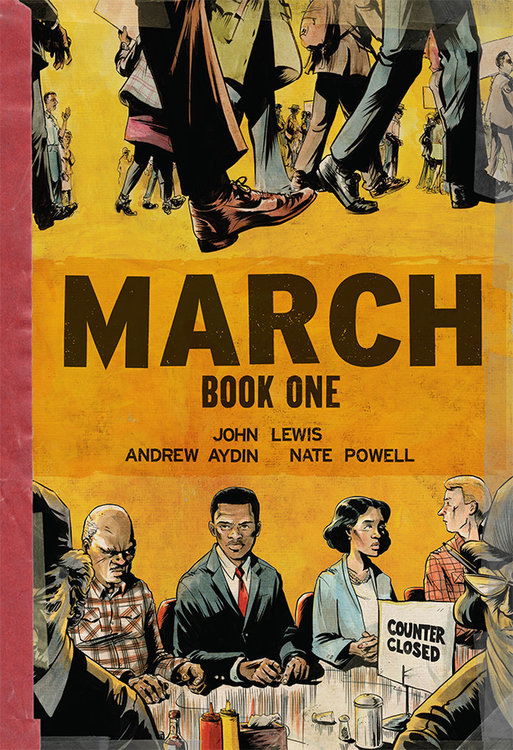
March: Book One 
By: John Lewis, Andrew Aydin and Nate Powell


The first volume of March is a very powerful story about the Civil Rights Movement and blacks marching the streets to protest for equal rights. The story developed around Congressman John Lewis  his extraordinary life's history, accomplishments and the movement he lead. During the beginning of the story they write about the events of the very christian praying protestors getting arrested for being in a bar or refusing to move sitting in the back of the bus. Eventually there were so many people in jail the policeman decided to let them go. "Bloody Sunday," was a very aggressive time when they were fighting for equal rights, marching and where police were blocking their path. They were then attacked after John Lewis's orders with many getting injured. It then jumps straight to Obama's inauguration. We notice Lewis is telling his story to people who visited him in his office in congress.

Lewis, Aydin and Powell create a comic book with a strong vision, message and storyboard like illustrations using a lot of graphic lines to communicate the emotion. They use very dramatic compositions and simple character designs, which communicate the story very well. Powell uses a very interesting technique using black, gray and white washes and markers to create some really good storytelling. They succeed in describing Lewis's life story and his becoming of a true and very prayful christian and civil rights leader. His life was very extraordinary. He held funerals for chicken that died instead of eating them or throwing them away. He also spoke of Ghandi, talked about the Montgomery Bus Boycott, War Resistance and Nonviolence. They reference racism and how evil it was, how evil poverty was and how evil war was. They just do such a great job with capturing us in the moment and to me it felt like I was part of the civil rights movement and experienced a time of such hardships for the blacks.


Tuesday, February 28, 2017

Maus: A Survivor's Tale - Art Spiegelman 


This is a comic book by the cartoonist Art Spiegelman is a very historic comic book.  This comic is a great survivors tale of Artie's father and the love of his life. This comic did a great job to separate the Jews from the Nazis. The mice are portrayed as they jews and cats as the Nazi's, which is a very imaginative way to tell the story during WWII. Vladek was a prisoner of war in a concentration camp who survived. It goes into a great amount of detail behind Artie's father how he was a prisoner of war and ended up surviving based on the priests accusations of looking at the numbers on his arm, which was very interesting. It was horrible learning about the Nazi's actions towards Jews. They did so many horrible things to them, which was disturbing but intricate to the story and what happened in Germany during the Holocaust.

Artie from the beginning of the comic starts documenting his fathers history. So his father is telling him his story when Artie himself is writing it. I think this is an interesting way to write this comic, which I really enjoyed with the animals. The suicide of the mother and the father burning his stuff is the reason why he wants the information from in father is because the evidence was destroyed.

Vladek was kind of a pain in the butt. He was a stickler for everything and even went out of his way to throw Artie's old jacket in the trash because he thought it wasn't "good looking enough." He was very wealthy and when he remarried Mala takes all his money, which is why she marries him.

The drawings are very distorted, stiff and very rough, which I though was relevant to the subject of the story, but are not masterpieces. The drawings are graphic, but because of the stereotypical imagery the approach adds a little humor to it because we wouldn't think of the idea of animals taking the place of Jews and Nazis.

This is an important comic to read because of it's historical background and interesting way to convey the Jews and the Nazis. It was a great thing to experience reading as I was not alive during this time and was able to read about it.

I read this comic freshman year of high school so it was interesting to read it eight years later at a more mature age and think much differently about it now. When I first read it I didn't understand why there were mice and cats and I was very confused. Reading it in college I understand Art's way of depicting the Jews and the Nazis. He did it this way because cats tend to chase and eat mice, so the cats are in charge, which is a very powerful way to write this comic.




Tuesday, February 21, 2017

Mr. Natural - Robert Crumb


Robert Crumb's Mr. Natural is one of his most popular characters. In this comic strip he really pushes the political satire by using a lot of profanity and excessive use of uncensored nudity not appropriate for young readers. The really exaggerated and cartoony figures add humor to the overall narrative of the story, which is solid. The old man seems to be very mischievous and adventurous by doing things that others dislike. The woman in this comic are portrayed as animals instead of people based on Mr. Naturals vulgar actions towards the baby. He tends to make fun of the "homeless person." Someone that does not have enough money for clothing. Crumb also makes fun of a beggar by Mr. Natural teasing him. Mr. Natural gives his money to a kid walking by right in front of the beggar. I did not care for this at all. His behavior towards the poor is hard to see because everyone is trying hard to get a job in this economy and I am always seeing people on the side of the street trying to survive. This shows how many people treat beggars and homeless people. Most tend to ignore them because they are perceived as dangerous, even though some can be very nice. The expressions on there faces are very simple, but they get the characters expressions across rather successfully. At the beginning of the comic in the Sunny Side Up story there is a little use of rhyming, which is a unique way to start a comic book, which gets the reader into a good mood. The cross hatching at times tends to be a little overwhelming in certain places and uses a good amount of cross hatching in others. 

I thought this was an interesting comic, but I did not care for the subject matter that much because it made me very unsettling and was very disturbing. I am not a fan of the way artists, tv, magazines, newspapers and any social media depict woman today and even when this comic was being created. I can see why most woman would not think about reading this comic. Woman are people too and are just as equal to men in my eyes. Robert Crumb made me laugh a little in this comic, but it did not really speak to me in a positive way but a creepy and hostile way. 

Sunday, February 12, 2017

A Contract With God - Will Eisner 
A book cover.  In the lower right, a man wearing a trenchcoat and hat climbs a staircase in heavy rain.

Will Eisner's, "A Contract With God" is a powerfully written and well executed comic, which reminds me of a crime noir and an emotional relationship with God. The illustrations are composed in a simple manner emphasizing key moments of each scene with lots of drama. The realistically drawn buildings, cartoony characters and expressions complement each other with the story. The scenes with the rain are inked really expressively. You can see the rain just pouring down. There are huge puddles and does a great job drawing the rain drops.

The man, Frimme Hersh, is a very compassionate man who has a contract with God. He is a brilliant man and lives in a pour town. Even though he lives in a harsh reality he doesn't complain about it. He does good deeds for people and tells them ,"God will reward you!"This is very symbolic to the whole meaning of the entire story, which is the mans emotional and psychological connection with god. It elaborates on the idea that if you do an act of kindness for someone something good will happen to you as a reward. He is a hero for helping people at the beginning of the story; the end of the story after his child died his contract was broken with god he wanted to start his life over. After his child died he turned greedy because of the riches he had, which is when he wrote and signed a new contract. I can relate to this since I have the same compassionate personality of the man and a deep relationship with God myself.

Thursday, February 2, 2017

Uncle Scrooge in "The Fabulous Philosopher's Stone"


This is an excellent Disney comic that takes the classic greedy Uncle Scrooge character and sets his sights on something more valuable known as the Philosophers Stone. Once Uncle Scrooge reads about it he wants it. He wants it because it will make him gold and get him more rich. On this journey he bring along Donal Duck and his three nephews.

The Philosophers' Stone is also shown in Harry Potter and the Sorcerer's Stone and The Flash Season 3 tv show. Even though the ideas around this stone are somewhat the same they are used differently. In this story the stone creates gold out of anything. In Harry Potter the Sorcerer's Stone helps Flamel live forever. And the Philosophers stone from the flash brings Savitar (the main villain of the Flash Season 3) to life, but it can also make him vanish into the speedforce.

The story was very fascinating and well-written. It is an easy read with very fluent narration from scene to scene. The expressions and character attitudes bring a lot to the comic. They show anger, happiness, joy, annoyance and many other types of feelings. The color was very modern and vintage. There were a bunch of different camera angles in the beautifully drawn compositions, which added a lot to the dramatic scenes especially. The black shadows work very well to popping out the focus of each composition. The detail is suggested gesturally, but adds a very accurate look to buildings, props and the placement of the characters in each scene.

Uncle Scrooge is a an interesting creation by Disney. He seems to be a take on Charles Dickens: A Christmas Carol, which has had a lot of versions and remakes of the story. I really like his character at the end when he realizes that there is more to life then just money. So, he learned his lesson in the end, which is great for young readers to learn about. This comic shows how greedy Uncle Scrooge is because of his deep desire for finding the philosophers stone to make more gold.